By Editor in Chief Jack Brady.
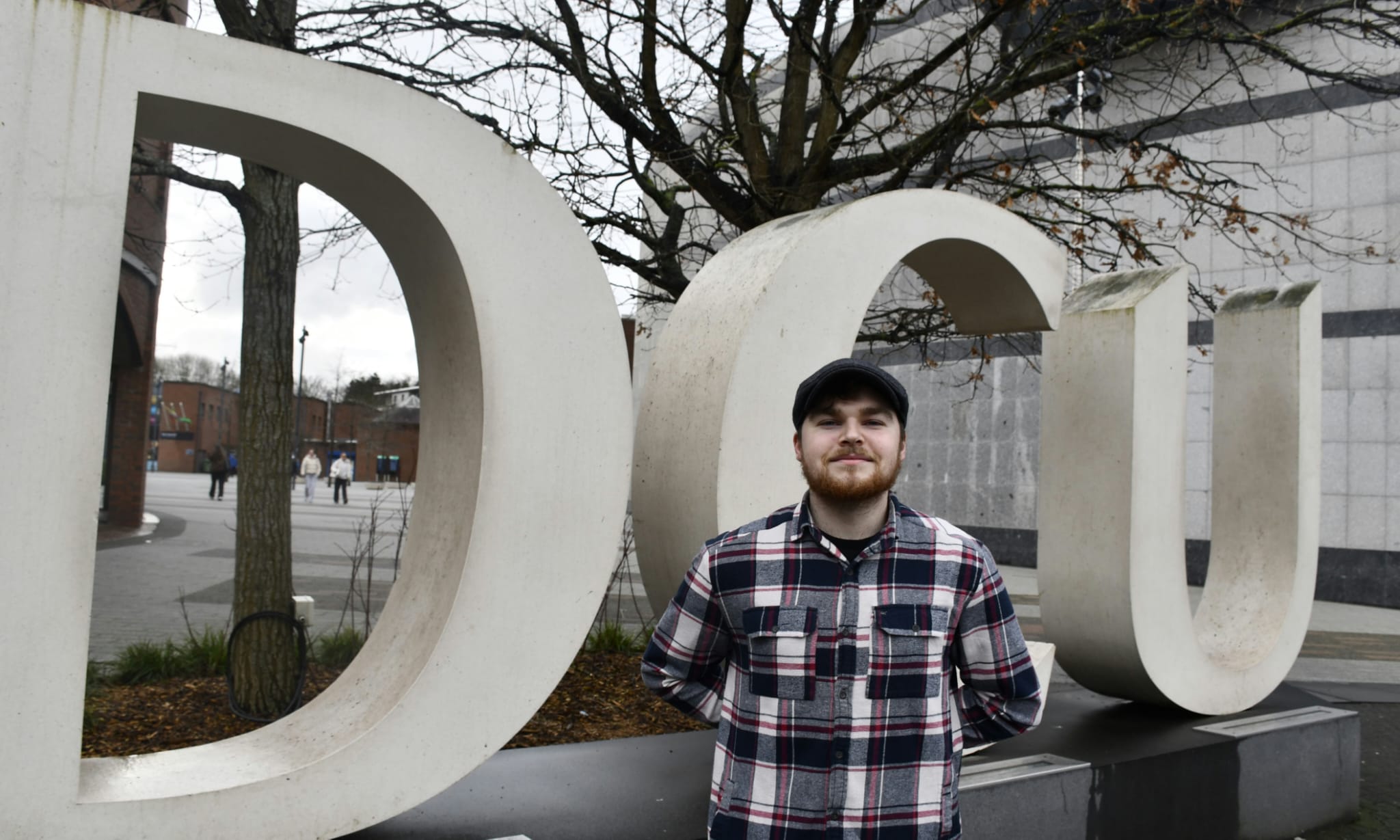
I meet with Peter Lawlor in the restaurant on Glasnevin campus, sheltered from the torrential rain. Despite the gloomy weather, the candidate for Students’ Union President is upbeat, animated, and notably prepared.
After exchanging niceties, he lets me know he’s got a horse running soon that we should all take a punt on, before speaking briefly of his Wicklow home, but who is Peter Lawlor, and what does a Students’ Union look like under his presidency?
A Peter Lawlor presidency aims to be one that students can’t look away from. From an admittedly catchy slogan in “you can’t beat Pete”, to a commitment to slumming it with students in the Glasnevin restaurant as opposed to the “elitist” 1838 club, his priorities lie with visibility.
Running for President
Lawlor has served as the Class Representative for International Relations for two years now, also lending a hand to the International Relations Society as their secretary for the academic year.
The presidential candidate believes he has been very successful in connecting with his students, changing timetables and acting as an “open and friendly” representative.
Accessibility is a key focus of Lawlor’s campaign, building from his previous experience.
“I’m here in the canteen, yet I have not seen many Students’ Union officers in the canteen here. They prefer the 1838 club with Dáire Keogh,” Lawlor remarks.
“I prefer a chicken roll from Londis, and a nice little spice bag in the canteen, surrounded by my students,” he adds.
His commitment to a ‘man of the people’ persona surrounds his political pragmatism when it comes to the candidate’s extended manifesto.
The Policies
Like most before him, Lawlor’s top priority is accommodation. But his exact idea for DCU housing is one you may not have heard of before.
Through actively “pursuing” landlords, Lawlor’s Students’ Union would act as a third party to connect students with landlords.
While DCU does already allow landlords to advertise rooms to students, this unique policy would see accommodation being advertised through the creation of a “hub” on the Student Union website in order to accumulate availability for the students to save time researching themselves.
The task simply put is to “actively promote alternatives to on-campus accommodation”, that would then create, as Lawlor puts it, a “quasi-free market”.
As someone who has worked in construction with his father on projects in Stillorgan and Donnybrook, he sees this approach as pragmatic in comparison to the previous “utterly unrealistic” accommodation policies of past Students’ Unions.
The issue of rising costs for accommodation in DCU is something that Lawlor notes is at the fault of the “near monopoly” the university has over its accommodation, and that he believes competition will drive down the price of student housing.
Lawlor himself is a “cash-based” renter, living in Dublin with “a lovely grandma”.
While housing has a near monopoly of its own on our conversation, another policy outlined is Students’ Union events in DCU.
The candidate believes that, “for Glasnevin, a quality over quantity approach is needed,” where he would work together with cultural societies such as the Eastern European Society, the Indian Society, and Ukrainian Society, the chairman of which Lawlor is a “very good friend of”, to promote diversity in DCU.
In the comparison of campuses, the “disproportionate amount of events that happen in Glasnevin” is an issue sought to be rectified by a Peter Lawlor presidency.
As for a third key issue his presidency seeks to raise; activism should be at the heart of a new administration.
“The Students’ Union is one great big megaphone,” Lawlor notes.
The candidate continues to articulate his belief that the platforming of activism for certain causes go unnoticed, placed in the background while others are voiced succinctly.
In Ireland, Lawlor points out the need for the platforming of the muslim and jewish populations in the state.
The Election
Lawlor remarked in his three point introduction on the nominations page that he is not afraid to be unpopular, something that he doubles down on as we talk further about his position as Equality Officer for Ógra Fianna Fáil in DCU.
“I think some people will be very swift to judge me for that,” he points out.
“Some of whom may first dismiss me for that, will look deeper, and see that the political connections that I possess are far more useful that the current unpopularity it might bring,” he adds.
Lawlor calls himself a “classical Fianna Fáil-er”, believing in a united Ireland, while trying to be a “good, catholic lad”.
As DCU, through manifold activism on predominant issues that would be considered by some to be left-wing in their actions, it begs the question; how does Lawlor plan on winning over a student population with a background linked to a currently unpopular party for young people in Ireland?
A further hindrance that may arise for Lawlor is his friendship with original founding members of the Student Supporting Israel (SSI) DCU branch that caused controversy on campus last March.
“I am a man who will listen to all opinions, even those I disagree with,” Lawlor explains before adding that, “I am a good friend of the chairman of Ukrainian Society, who was a founding member of the SSI, and I am also friends with people who are in BDS (Boycott, Divest, Sanction) because as a democratic representative, I believe it is my duty to listen to all people, even those I disagree with”.
“I wouldn’t say I’m a big supporter [of SSI], in fact I’d say I’m the opposite,” he says.
What sets Lawlor apart
While admitting that he shares the issues of his fellow candidates, Lawlor believes he possesses the “most pragmatic solution”, particularly for delivering accommodation to students.
That pragmatism relates back further to his reflection on the outgoing union, of which President Shane Murphy’s policies were “not up to snuff”, according to Lawlor.
“While I have nothing but respect for him, and his work, and for all of the outgoing regime, I do think that promises were made and not kept,” he clarifies.
“I was there when I heard that more accommodation would be built. As a student representative, I was there when I heard that it would be delayed. And I am here when I see that it has not been provided.”
The continued delays and ostensible lack of improvement for students in need of accommodation has evidently called Lawlor to action.
“There is something rotten within the current state of DCU, and I think I will burn that rot.”
Purging that rot, so to speak, is a key theoretical issue that the candidate concludes our discussion with, before reverting back to his campaign slogan, with a preface of what is ostensibly a personal mantra.
“Peter Lawlor does not back down. Peter Lawlor stands his ground. Why? You ask. Because you can’t beat Pete,” Lawlor barks.