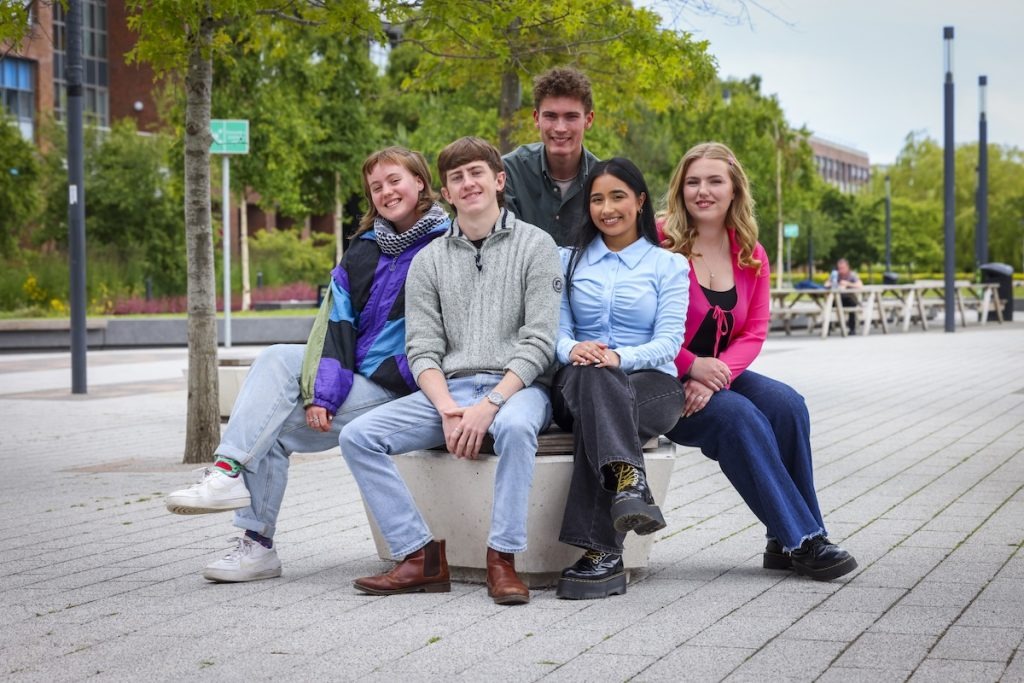
By Amanda Uwase, Erica Elliot, Ciara Clarke, Lucas Spicer and Felix Mordaunt.
Malha Muhammed, Lauren Joyce, Sean Greene, Emily Cathcart and Shane Murphy made up the full-time sabbatical officer team of the Dublin City University (DCU) Students’ Union (SU) for the academic year 2025/26. The DCU Bulletin reached out to the officers individually to hear what they had to say about their time in office.
VP for Diversity and Inclusion Malha Muhammed – Amanda Uwase

Sat outside in the sun, a rare occasion at DCU, we found Malha Muhammed taking on the role of a diplomat as she pulled up her stats and slides. “Is that enough information?” she asks, almost instinctively. I had only asked for an interview; what I got felt closer to a full presentation.
One of the key events that took place, which the VP for Diversity and Inclusion hosted for the first time, was Multicultural Week. Muhammed brought together flavors and races from all over DCU to display the rich culture the university has to date. Alongside this moment, she cheerfully spoke on how she had championed ethnic minority representation, consistently using her platform to spotlight underrepresented voices while embedding stronger collaboration between societies and the Students’ Union (SU).
She reminisced on her journey, which is nothing short of inspiring. Following a meningitis diagnosis, Muhammed’s focus sharpened on access to support services. She worked to ensure students navigating challenges behind closed doors could find clearer, more accessible pathways to help, something she felt was missing during her own early experience.
Students reported feeling seen, celebrated, and connected, whether through cultural events, charity initiatives, or simple conversations. Muhammed’s hands-on approach, rooted in active listening and genuine care, positioned her as more than an organiser; she became a trusted advocate. By exceeding her original goals and embedding lasting initiatives, she leaves behind a legacy defined by empathy, hard work, and a deep commitment to improving the student experience.
Her manifesto translated intention into measurable impact. Muhammed engaged hundreds of students weekly, led impactful initiatives such as Black History Month and Multicultural Week, and helped raise nearly €2,500 for five to six ethnic minority organisations.
Multicultural Week alone featured 40 stalls and 27 external vendors, raising over €1,300 for charities, while Black History Month contributed an additional €500. Beyond events, she played a key role in the Race Equality Action Plan (2025–2028), a framework that outlined more than 130 actions to tackle racism and improve inclusivity across campus, demonstrating her commitment to long-term structural change, not just surface-level activity.
VP for Wellbeing Lauren Joyce – Erica Elliott

We met in the helix at midday, iced coffee in hand, and Lauren spoke of the promises she’s proud to have delivered. Mentioning her manifesto, she opened it up on her phone and said, “I think one thing that’s really hard for people to understand is that a manifesto is like a guide of what you’re going to do”.
She said she would ask people to look beyond the manifesto and at what else is being done. Speaking of her initiative to have more period products in stalls, she said she would probably not achieve this until she finishes her time as VP for Wellbeing.
As for one of her favourite moments – one she’s proud of – she spoke of organising Shag Week. Blown away by the number of people that attended the events, she said, in regards to safety measures, such as consent talks, “One thing we find is that talks…no one ever shows up”. Although she did say briefly that they were able to run these talks during freshers at the beginning of the school term.
Flashing back to the Aontas na Mac Léinn in Éirinn (AMLÉ) motion, she said, “it was messy, to be frank”. Reverting specifically to the wording of the last page of the elections document, she said people were confused about what it meant. For herself, she thought this should have been brought to the attention during the Class Representative Council (CRC) meeting. In turn, she said she also wasn’t content with the amount of effort that was put into the campaign, alleging she and SU President Shane Murphy did most of the campaigning.
While she wishes she had more time for the breast and testicular cancer checks, she touched on the event which she spearheaded for Movember, raising €1,200.
In response to criticism the team has faced, she adds, “calling us names on DCU confessions, it’s not kind”, mentioning that she encourages people to attend CRC meetings, and to use them to voice their concerns. “But it does come down to a point where each person does have the responsibility themselves to deliver on their promises”.
VP for Academic Life Sean Greene – Felix Mordaunt

When reached out to for an interview, outgoing VP for Academic Life Sean Greene declined. Greene took over the position in June of 2025 and said in a social media post that after summer exam results were published, he supported over 180 students with academic issues and queries. Greene also oversaw the election of over 500 Class Representatives to the CRC.
In what he described as a “natural next step”, Greene ran for Students’ Union President in the 2025/26 elections. In his campaign, he promised, if elected, to build a union that was “laser focused on the cost of living”. He spoke about the high cost of commuting, the cost of living on campus, and the lack of purpose-built student accommodation. Greene has a long history of being involved in student politics and supports, being a class representative as well as working for the Office of Student Life.
Greene’s time as VP was not without controversy. On 10th February, during a CRC meeting, VP for Community and Citizenship Emily Cathcart criticised Greene’s performance as VP for Academic Life.
Among other things, she criticised the promotion of his presidential campaign while there was work to be done, and alleged that his work on exam support services was inadequate. In response, Greene said he never allowed his campaign to get in the way of his VP duties, and said her claims were “categorically untrue”.
At a later date, Cathcart further criticised his alleged unreliability in helping out with organised SU events and his alleged lack of promotion of CRC 1 on social media, among other things. She said that her concerns had been ongoing and worsening since July.
Greene said that as VP for Academic Life, his focus was on academic matters. However, he admitted he could have done more to promote CRC. Greene cited the Constitutional Review Working Group, a constitutional review of the SU, as well as his engagement with class reps, as examples of his work and commitment to his role as VP for Academic Life.
Speaking to students about his time as VP for Academic Life, Greene was not consistently linked by students to one standout achievement. Instead, he was described more as a supporting presence across wider SU efforts. One student said they had seen him at events “working in the background a lot, really helping with the logistics,” particularly during Union-led initiatives. Another offered a simple summary: “I think he’s done an alright job… I’ve seen him around the place. He’s done his thing.”
VP for Community and Citizenship Emily Cathcart – Amanda Uwase

We meet Emily Cathcart over tea in her softly lit office, a setting that mirrors both the calm and complexity of her term as Community and Citizenship Officer. Her manifesto, “sustainability, solidarity, and togetherness,” was geared toward her proudest project, the longly neglected community garden.
“It took so much work to get there,” she said, recalling stalled progress, circular conversations, and the drag of bureaucracy and risk assessments. The project, unkept since 2019, was revived with support from Sam Fahy, sustainability officer. Though illness halted its official launch, there’s a possibility it will happen in the next academic year.
Cathcart’s term leaned heavily into student empowerment. From Trade Union Day, drawing hundreds across campuses, to co-leading Seachtain na Gaeilge alongside the VP for Diversity and Inclusion Malha Muhammed, she emphasised collective action.
“Students can be such a political force when they are unified,” she said. She is closely involved in DCU Boycott, Divestment and Sanctions (BDS), though careful in how she frames that engagement publicly.
When asked about her own arrest, she said it had no impact on her role as Community and Citizenship Officer and refused to comment further due to it being a personal matter.
The VP for Community and Citizenship still has unfinished business with the role, wishing she did more advocacy than events. For Cathcart, that means lobbying at a national level and pushing institutions to meet their duty of care to students, rather than relying on temporary fixes.
President Shane Murphy – Lucas Spicer

For an officer who declined to be interviewed directly, the clearest verdict on SU President Shane Murphy came from the students around him: not glowing praise, not outright criticism, but a sense that he had contributed to an SU that felt more active and more present this year.
Among students interviewed, Murphy was most strongly associated with one issue above all: food. One student recalled his campaign “very vividly,” especially the promise around “cheap lunches,” adding that while the final version may not have matched the original ambition, “he’s gone and done it.” The recent rollout of subsidised lunches was seen as proof that at least one major campaign theme translated into action.
More broadly, students felt the Union as a whole had stepped up its activity compared to last year. One interviewee said, “The SU really put out a lot more than last year in the sense of events and stuff,” pointing to a busier campus atmosphere, even if they themselves had not always been around to experience it directly.
For students in demanding courses, especially those balancing internships and major projects, that increased activity was often observed from a distance rather than up close. Still, one student said that through emails and online updates, “the SU was very, very present this year.”
Murphy appeared to benefit from being associated with visible, concrete measures like low-cost food. In student politics, visibility matters, and several students suggested that Murphy wasn’t always as visible on campus as they might have expected, with one student saying they had not seen him “around as much on campus.”
Still, the overall mood was not negative. If anything, it was measured and mildly approving. Students may not have been able to list every initiative, but the sense was that Murphy had helped deliver a year in which the SU felt more active, more organised, and more engaged than before.