By Szymon Standa.
Winning the recent DCU Sustainable Development Goals (SDG) Hackathon was an exciting moment for our team, but what followed afterwards made the experience even more remarkable.
In the days following the competition, our idea began to gain attention beyond the university.
Winning the Hackathon provided our team with radio coverage, encouraging feedback from the Minister of State for the Department of Agriculture, Food and the Marine, Noel Grealish’s office, and opened the door to potential conversations with relevant government and research channels.
What started as a student competition entry quickly evolved into a wider discussion about innovation, climate action, and the role students can play in shaping practical solutions to real-world challenges.
Our team developed an idea aimed at reducing methane emissions from cattle by introducing seaweed-based mineral lick blocks for livestock.
Methane is a significant contributor to global warming, and agriculture remains one of the most complex sectors when it comes to reducing emissions while maintaining productivity. The goal behind our concept was to explore a practical approach that could reduce methane output from cattle without disrupting farming practices.
More than 20 teams competed in the DCU-wide competition, which brought together students from across the university regardless of discipline or academic background.
That diversity gave the hackathon a genuinely interdisciplinary character, with teams combining perspectives from computing, business, engineering, and environmental studies.
Events like this show that hackathons at DCU have grown far beyond high-energy competitions. They have become environments where ideas are tested, teams are formed quickly, and students are pushed to think clearly and execute under pressure.
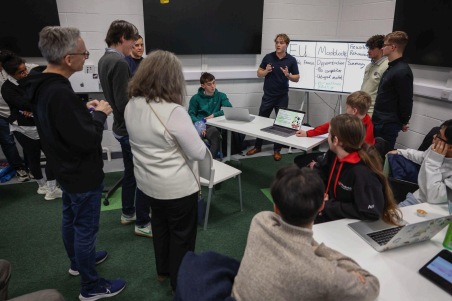
During the SDG Hackathon, organised as part of the DCU Innovate Catalyst programme, teams were challenged to develop solutions aligned with the United Nations Sustainable Development Goals within just a few hours.
One of the most interesting aspects of the experience was how quickly our team had to move from a rough concept to a clear and structured idea.
As my teammate, Lucas Spicer reflected during the event, “You realise very quickly that having a strong idea is not enough. If the team is not aligned, nothing moves. Once everyone commits to the same direction, progress accelerates.”
That observation captures an important truth about innovation environments. The teams that succeed are not necessarily those with the most complicated ideas, but those that communicate clearly, divide responsibilities effectively, and maintain momentum throughout the process.
Joseph Lanzillotta from DCU Innovate, who leads the Catalyst Student Entrepreneurship Programme and helped organise the event, highlighted the value of that challenge when speaking about the hackathon. He explained that the experience pushes students to challenge themselves, step outside their comfort zones, and attempt to develop new ideas in a very short period of time.
For our team, the hackathon proved to be only the starting point. Following the competition, we had the opportunity to discuss the idea further during an interview on NearFM radio, where we reflected on the experience and explored how a concept developed during a short competition could potentially evolve beyond the hackathon setting.
My teammate, Tadhg Plunkett later reflected on how important interdisciplinary collaboration was to our success. “Each team member approached the challenge from a slightly different perspective, whether technical feasibility, environmental impact, or business viability. Bringing those viewpoints together helped shape both the idea and the final presentation.”
Looking back, what makes the experience particularly encouraging is that the idea did not end with the hackathon itself. The radio coverage, ministerial encouragement, and interest from external stakeholders all demonstrated that student-led innovation can extend well beyond the university environment.
Experiences like this highlight the growing role of universities not only as places of learning, but also as platforms where students can test ideas that contribute to wider societal conversations.
The DCU SDG Hackathon showed that with the right environment, a few hours of focused collaboration can cultivate ideas capable of reaching far beyond the classroom.